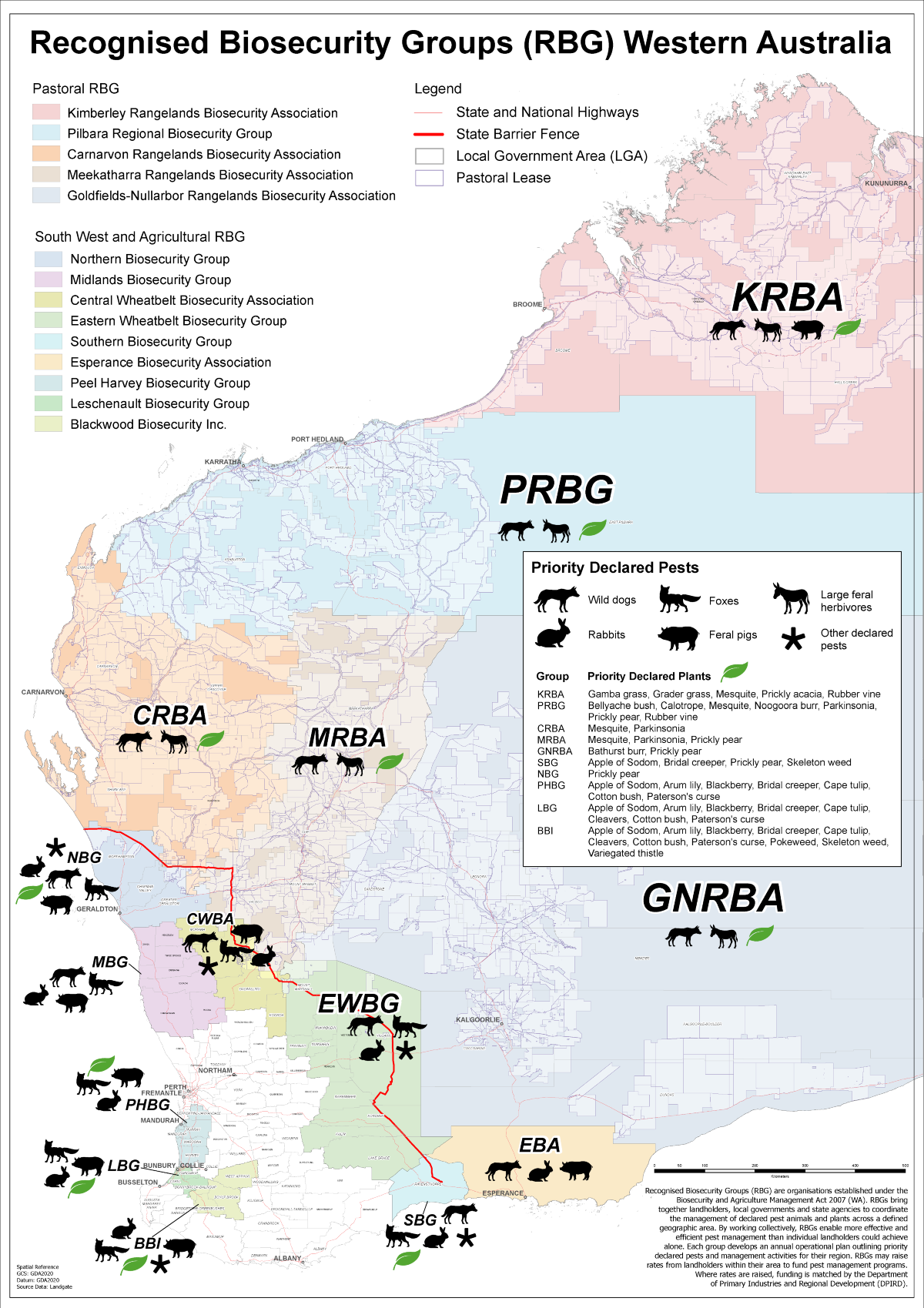
Western Australia has 14 Recognised Biosecurity Groups (RBGs), each focused on the priority declared pests relevant to its Operational Area. Declared Pest Rate funds collected within each area are directed to its local RBG to support community awareness, education and coordinated management of those priority pests.
Around this time each year, many landholders across Western Australia receive a notice from the State Government for payment of the Declared Pest Rate (DPR).
For some, particularly those who may not have had direct interaction with their local Recognised Biosecurity Group, that notice can prompt a reasonable question: What is the Declared Pest Rate and what does it help fund? What is the Declared Pest Rate? The Declared Pest Rate is a land-based rate collected by RevenueWA under Western Australia’s Biosecurity and Agriculture Management Act 2007 (BAM Act) to help fund efforts to support the management of declared pests.
A declared pest is an animal or plant species that has been declared under the BAM Act because of the impacts it can have on people, the economy or the environment. These include invasive animals such as European rabbits, red foxes and feral pigs, as well as specific invasive weeds that can impact individual properties, neighbouring land, agriculture, our natural environment and the broader community. Depending on the species and its status in Western Australia, declared pests may be subject to requirements aimed at preventing their introduction or, where already established, subject to keeping requirements or requirements for managing their impacts and spread.
The particular declared pests present, and the challenges associated with managing them, vary considerably across the State. In areas where a DPR applies, the State Government matches the funds actually collected dollar-for-dollar, increasing the funding available to support declared pest management within those areas.
Where does the DPR go? DPR funds collected within an area are provided to the Recognised Biosecurity Group (RBG) operating in that area to support the management of that area’s priority declared pests.
Locally, DPR funds collected within the Leschenault Biosecurity Group (LBG) Operational Area are directed back to support declared pest management within that area, which encompasses the Shires of Capel and northern localities of the Shire of Donnybrook-Balingup (including Argyle, Paynedale, Beelerup, Queenwood, Lowden, Yabberup, Glen Mervyn, Mumballup, Noggerup, Thomson Brook, Charley Creek, Donnybrook, Brookhampton, Brazier, Newlands, Upper Capel and Kirup) and the City of Bunbury.
Pest management priorities vary greatly across WA. In some regions, for example, a significant proportion of available resources may be directed towards the management of wild dogs, large feral herbivores such as donkeys and camels, varied grasses, mesquite and other invasive species. The DPR’s locally focused model allows funding and activities to respond to the declared pest challenges most relevant to each region.
What does the DPR help Recognised Biosecurity Groups provide?
The DPR does not transfer responsibility for declared pest management from individual landholders to the local RBG, nor does payment of the rate provide an individual pest control service to every ratepayer. Rather, DPR funding supports the management of priority declared pests across communities. It enables RBGs to support landholders in meeting their responsibilities to manage declared pests on their private properties with a range of resources, while also facilitating broader, coordinated approaches to declared pest management across their Operational Areas.
Depending on the pest, program and circumstances, this support can include practical management guidance, property visits, equipment loans, free or subsidised pest management resources, workshops and demonstrations, coordinated control programs and, where applicable, on-ground services.
DPR funding also supports RBGs in meeting their responsibility as a Recognised Biosecurity Group to build community awareness and knowledge about the region’s priority declared pests, why their management matters, available control options and the resources available to support landholders in managing them. It also enables RBGs to help raise awareness of emerging biosecurity threats that may pose a future risk to their areas.
Importantly, pests don’t recognise property or tenure boundaries. DPR funding also enables RBGs to collaborate with landholders, neighbouring land managers, local governments, State Government agencies, peer biosecurity groups and other organisations to encourage and facilitate coordinated approaches to pest management. Locally examples include LBG’s annual Calicivirus RHDV1 K5 Release Program supporting coordinated rabbit management and its Feral Pig Management Program, which provides landholders with resources and support to help manage feral pigs across participating properties.
Read more about the DPR and RBGs at the DPIRD website: www.dpird.wa.gov.au/businesses/biosecurity/biosecurity-legislation-and-governance/bam-act/declared-pest-rate/
Got questions or wish to discuss:
Re YOUR specific DPR invoice/payment – contact RevenueWA on 1300 368 364 (for country callers}
Re policy and general information regarding the DPR & RBGs – contact the Department of Primary Industries and Regional Development (DPIRD) at 1300 374 731 (choose Option 9)
Re Priority declared pest management programs/support available in LBG Operational Area – contact Leschenault Biosecurity Group: p 0477 049 967; e info@lbginc.org.au; website: lbginc.org.au
Recent Comments