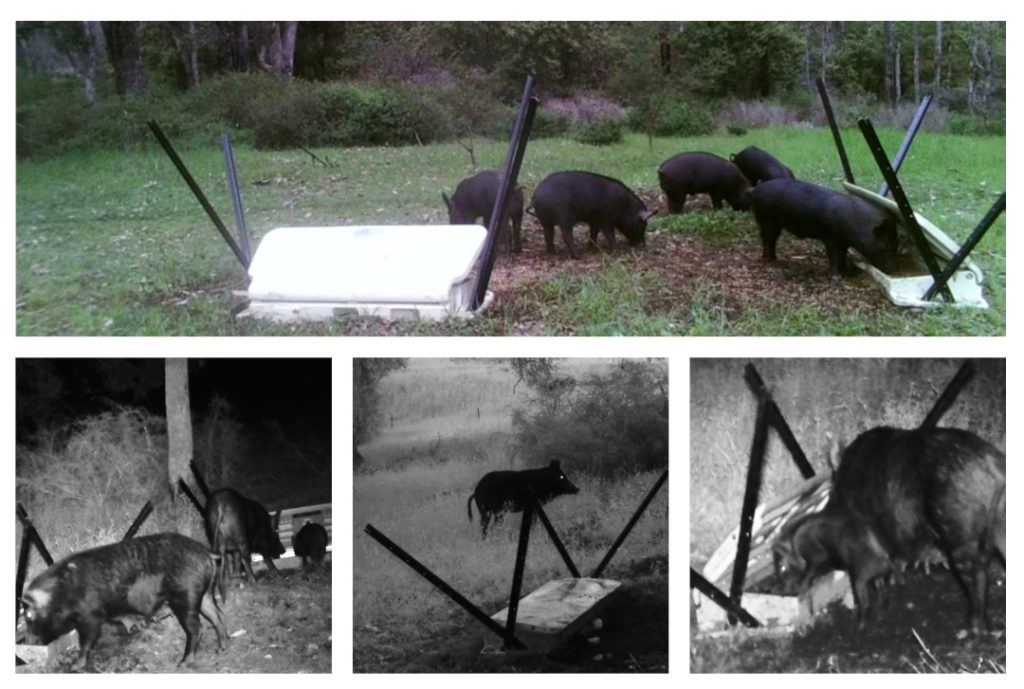
Images captured on surveillance cameras at LBG HOGGONE Feral Pig Control System Installations
Historically, domestic pigs were allowed to range freely with some inevitably became feral, living and breeding in the wild. Accidental or deliberate introductions of domestic pigs into the wild continue today. Feral pigs from long-established populations tend to be small, having longer snouts, heavier forequarters and shorter backs than domestic breeds. White and piebald individuals are quite common in the South West. Feral pigs are omnivores with a high reproductive potential, capable of surviving in many habitats and adapting to changing conditions. They are likely to have a considerable impact on the environments in which they become established. There is evidence that pigs spread the fungal pathogen which causes dieback disease. Feral pigs are also susceptible to several significant exotic diseases of livestock not yet present in Australia. These include foot and mouth disease, African swine fever, rinderpest and rabies. It is important to control feral pigs to prevent the build-up of large numbers.
Please note that the video presented below may take a few seconds to load for your viewing.
All images on this video were captured on LBG monitoring cameras as part of our feral pig control installations on local area properties for which landholders requested our support for Feral Pig Control.
LBG works with private landholders to deliver an effective feral pig control program, primarily using the HOGGONE® Feral Pig Control System. This system is a core component of our coordinated Feral Pig Control Program, providing a reliable, targeted baiting method that can be adapted to pig activity and property-specific conditions.
The Leschenault Biosecurity Group (LBG) delivers a robust feral pig control program in collaboration with private landholders across our Operational Area. Since 2020, LBG has incorporated the HOGGONE® Feral Pig Control System as a key tool for humane, targeted feral pig management.
LBG was the first group in Western Australia to trial the use of this system for feral pig control. The system utilises HOGGONE® meSN® Feral Pig Bait and the purpose-designed HOGGONE® Bait Box. This baiting system includes a species-specific bait formulation, and a box design that allows pigs to smell and access the bait after a pre-feeding phase, while keeping non-target animals, rain and extreme heat away from bait placed inside the box. This program typically is conducted over approximately 10-day, allowing the pigs to become comfortable with the Bait Box. Over the span of a single project installation, we often are able to attract several additional pigs than were originally sighted, enabling removal of multiple feral pigs through one installation.
We conducted our first trial of this system in 2020 working in collaboration with a landholder on his private property within the Donnybrook-Balingup Shire. The system proved to be particularly well suited to our peri-urban Operational Area where shooting or other control methods may not be practical or appropriate. Following multiple successful trial installations, LBG adopted this system as a core component of our feral pig management program.
Today, landholders experiencing feral pig activity regularly reach out to and collaborate with LBG to deploy this system on their properties. The approach supports humane and effective removal of feral pigs and forms a reliable, adaptable component of LBG’s broader Feral Pig Control Program.
Read more about this program, what’s involved from the link below:
LBG Successes Utilising the HOGGONE Feral Pig Management System
CONTACT LBG for property-specific advice:
Best practice methods for controlling feral pigs can vary, so for personalised advice please contact the Leschenault Biosecurity Group by e-mail: info@lbginc.org.au or phone on 0477 049 467
Recent Comments