
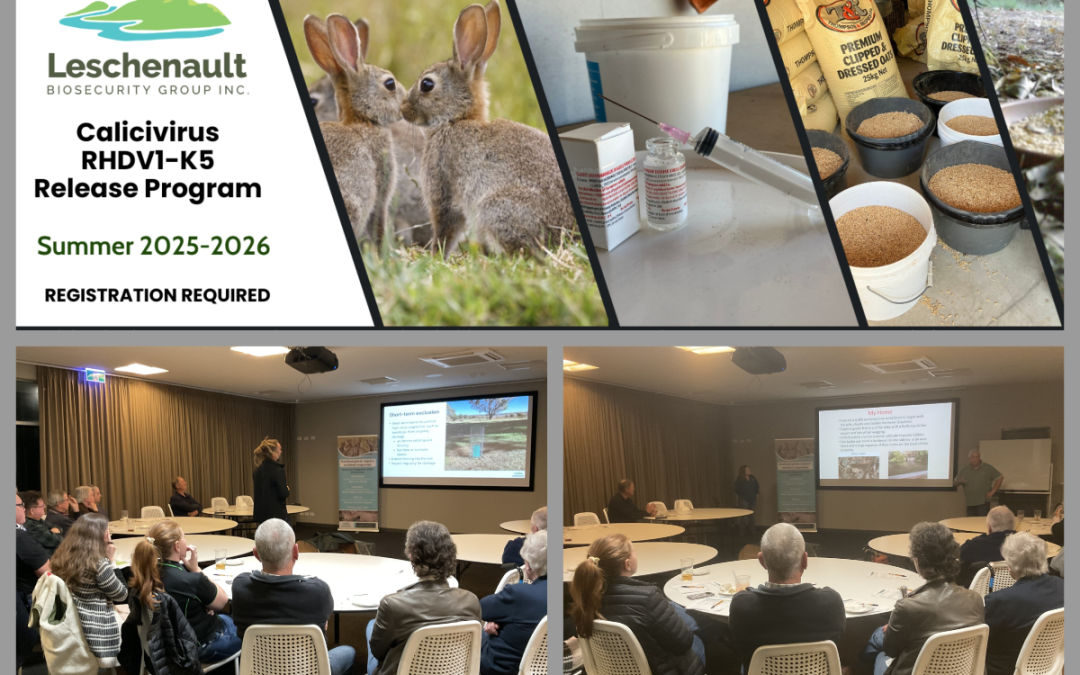
Shifting mindsets from viewing participation in an annual biocontrol release as a “silver bullet” to recognising the benefits of integrating multiple control methods into an ongoing, property-specific rabbit management strategy. Leschenault Biosecurity Group strived to reinforce this message in 2026 conducting an Integrated Rabbit Management Workshop, targeted to participants in the group’s annual Calicivirus RHDV1-K5 Release Program. Among the practical strategies presented, an LBG team member, and Licensed Pest Management Technician (LPMT), discussed the importance of vegetation and harbourage management, while a local landholder shared his success incorporating trapping into rabbit control on his small property. Together, these presentations demonstrated how complementary control methods can build on any successes achieved through biocontrol as part of an effective integrated controls management approach as best suits property-specific circumstances.
For several years, Leschenault Biosecurity Group (LBG), one of Western Australia’s 14 community-led Recognised Biosecurity Groups, has facilitated an annual Calicivirus RHDV1 K5 (K5) release program in collaboration with landholders across its peri-urban Operational Area. Participation in this program has grown significantly over that time. But LBG sees one of the most encouraging measures of this program’s success is not how many landholders are participating in the group’s annual Calicivirus “K5” release. It is what they are doing before and after this release.
LBG, which supports private landholders with resources for their management of declared pests on their private properties, has always promoted Calicivirus K5 as an important biocontrol tool, but not a “silver bullet”. Consistently stating that While a successful release can contribute to significant reductions in rabbit numbers, effective long-term management requires persistence and the strategic integration of control methods appropriate to individual properties and circumstances.
For many years, however, informal participant feedback suggested that LBG’s annual K5 release was often the only rabbit control action undertaken on participating properties. That appears to be changing!
From an annual event to one phase of an integrated management plan – LBG Is encouragingly seeing a noticeable shift in mindset among landholders with they are engaging.
Over the past two years, LBG formalised its collection of participant feedback through post-program surveys. Responses following these surveys indicated an encouraging shift, with many landholders reporting that they are using, or planning to use, other rabbit control methods beyond their annual participation in the group’s summer K5 release. The group’s conversations with landholders are changing too! Enquiries are moving beyond “When is the next release” to questions like “What should/can I do next?” and “What other controls could/should I use on my property?” Landholders are increasingly reaching out to the group for advice and other support around other control options including harbourage reduction, warren destruction, baiting, trapping, fencing and ground-shooting.
LBG is encouraged by this important shift in thinking. Rather than viewing participation in a “once-a-year” Calicivirus Release as a complete rabbit management program, the group is seeing that more landholders are recognising that this biocontrol is one tool for rabbit management as part of a necessary broader and on-going rabbit management strategy. The group sees this as an important measure in the evolving success of their overall rabbit management support program.
Beyond the Calicivirus K5 Release Program- Reinforcing the Importance of Integrated Management – In 2026, LBG evolved its community engagement approach to further reinforce the importance of not considering a Calicivirus K5 Release as a stand-alone rabbit control measure. As in previous years, the group conducted pre-release workshops providing participants with prescribed guidance and processes for participating in their release program, while reinforcing the importance of follow-up controls to build on any achieved reductions in rabbit activity. In 2026, however, LBG extended that engagement beyond the release itself by conducting a post-release Integrated Rabbit Management Workshop.
Open to all landholders across LBG’s Operational Area, but specifically promoted to recent K5 Release participants, this new workshop focused on moving the mindset from “How or when can I undertake a Calicivirus release?” to “What rabbit management strategy best suits my property circumstances?”
Empowering landholders with knowledge, practical guidance and a planning tool for implementation of their property-specific rabbit management plan
The group’s goal for this workshop was to empower attendees with knowledge and practical guidance to help landholders understand the types of and best timing for available rabbit control methods for development and implementation of their own property-specific management plan. To support this, LBG developed a working Rabbit Management Plan handout, using information from the Centre for Invasive Species Solutions’ Glovebox Guide for Managing Rabbits. This handout was provided to each attendee upon their arrival for their use throughout the workshop to consider which controls and in which sequence could be appropriate for their property-specific circumstances.
During the workshop, LBG staff discussed integrated rabbit management and the timing and combination of different control methods. A local landholder shared his experience of using trapping to remove over 130 rabbits from his small property and two Licensed Pest Management Technicians contributed their expertise on harbourage reduction through vegetation and weed management, and best practice and regulatory considerations for using ground shooting as a rabbit management tool.
LBG’s core message throughout was consistent: whether tackling an existing rabbit problem, building on reductions achieved through a Calicivirus K5 release, or improving an established control program, effective long-term results are best achieved with persistence and an integrated rabbit management approach tailored to property-specific circumstances.
Persistence applies to communication too
LBG doesn’t attribute this noted shift in approach from a “one-off” rabbit control effort to an integrated management approach mindset to any one of their messaging campaigns or initiatives. Instead, they see this as, like in rabbit management, the same applies to community engagement: persistence matters.LBG does not attribute this encouraging shift from a “one-off” control mindset towards integrated rabbit management to any single campaign or initiative. Instead, it reinforces that their consistent message about rabbit management that persistence matters also applies to community engagement. Through the group’s workshops, Calicivirus Program guidance, newsletters, social media and direct conversations with landholders about rabbit management, LBG has attempted to consistently reinforce that effective rabbit management rarely comes from a “one-off” effort, but rather requires persistence and typically with an integration of controls as best fits individual property circumstances.
Applying lessons learnt – LBG’s experiences continue to evolve its rabbit management support programs, including:
- Biocontrol remains an important tool in local rabbit management within the LBG Operational Area, as well as an important community engagement opportunity for the group.
In 2026, 134 landholders participated in the group’s Calicivirus K5 Release Program, distributing K5-treated oats across 479 release sites covering approximately 2,738 hectares of private property within LBG’s Operational Area. While participation was lower in number than 2025, encouragingly, approximately half of the 2026 participants were new to the program, and importantly new to engagement with LBG which provides for a broader reach for messaging around management of other priority declared pests.
LBG’s Calicivirus K5 Release program also provides a useful management option for known rabbit hotspots on local government and other public land. While LBG’s primary role is supporting private landholders with declared pest management, the group also works with public land managers where their capacity and supplemental funding allows, helping support more coordinated rabbit management across tenure.
- LBG’s Annual Calicivirus K5 Release Program participation must consistently be structured and promoted as a strategic component of a landholder’s broader rabbit management plan. Participation requires adherence to the group’s program guidance that has evolved overtime, including:
- Requiring participants to confirm a successful pre-feeing phase to proceed with a release on their property
- Excluding participation where landholders report signs of active myxomatosis or the presence of rabbit kittens
- Promoting best practice of allowing ~ four weeks following a release before implementing any other rabbit controls to maximise time opportunity for the virus to spread through the local rabbit population
- Strongly encourage follow-up control to take advantage of any reductions achieved through individual landholder’s release
- Screen registrants for the following year’s release with potential to not allow participation if it seems that they are relying solely on the one-off annual Calicivirus K5 Release Program as their only rabbit management action
- Defining the success of LBG’s rabbit management support program should not focus primarily upon the number of participants in the group’s annual Calicivirus Release Program. This is perhaps one of the group’s most important related “lessons learnt”. While participation numbers in the group’s annual K5 Release programs may vary, LBG is putting more emphasis on what other rabbit management activities landholders are conducting, moving from “when/how can I conduct a K5 release on my property?” to What should/can I do next to best manage rabbits on my property?” . The group sees this as a significant advancement in effectively promoting the need for an integrated management approach for effective long term rabbit management.
Recent Comments